
Mittelstand vs Food Corporation

Innovation meets reality: Why a colored T-nut wins – and a $100 million AI system fails.
Two LinkedIn posts, two innovations, one crucial lesson about Jobs-to-be-Done

Prologue: Two posts that tell more than their hashtags suggest
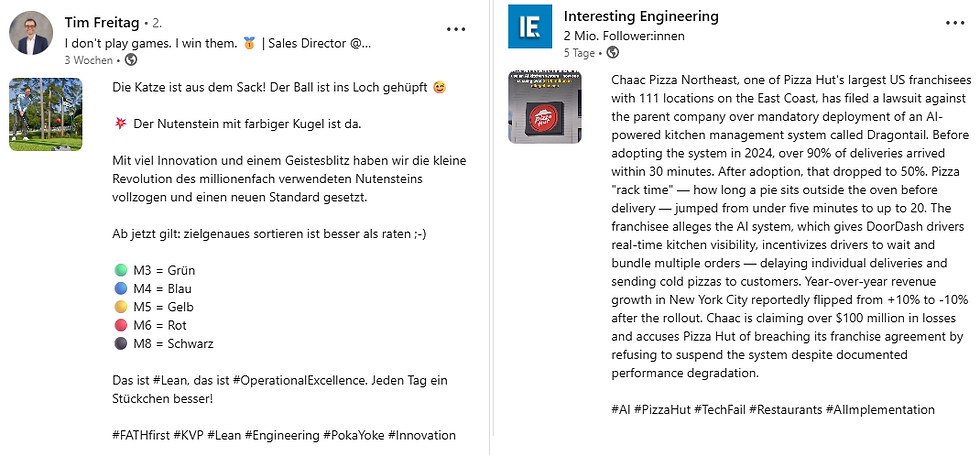
Two posts recently appeared in my LinkedIn feed that I immediately saved – not because of their reach, but because of their impact as a contrasting pair.
(Disclaimer: I was not involved in either development; all information used for this comparison is publicly available and the comparison is based solely on these publications. I have not verified the accuracy of the information.)
The first: Interesting Engineering reports that Chaac Pizza Northeast – one of the largest Pizza Hut franchisees in the US with 111 locations on the East Coast – is suing its parent company. The reason: an AI-powered kitchen management system called Dragontail , the implementation of which cost the company over $100 million in 2024, according to its own statements . Before the rollout, 90% of deliveries arrived within 30 minutes. After the rollout: less than 50%. Sales growth in New York City plummeted from +10.19% to -9.78%.¹
The second: Tim Freitag , Sales Director at the world market leader FATH Western Europe , posts almost casually : “The cat’s out of the bag! The ball’s in the hole.” Then comes the explanation: T-nuts – these connecting elements used millions of times over and ubiquitous in production – have been assigned colors . M3 = Green. M4 = Blue. M5 = Yellow. M6 = Red. M8 = Black. A new standard. “Precise sorting is better than guessing.” ²
Two innovations. One with a multi-million dollar budget, corporate strategy, and AI hype. One with color and common sense. And yet, the JTBD lens clearly shows: Only one of them has understood the actual job.
What exactly is the "job"? A brief introduction to JTBD.
The Jobs-to-be-Done framework , coined by Clayton Christensen and systematized by Tony Ulwick with his Outcome-Driven Innovation methodology, focuses on a radically simple question: What job does the customer "hire" a product or service to do?
This isn't about demographic data, product features, or technology. It's about the functional progress a person wants to achieve in a given context – and the emotional and social dimensions that accompany that progress.
Tony Ulwick describes the job using an eight-level job map :³
Define – What is being planned?
Localization – What resources/information are needed?
Preparation – How is the setup set up?
Confirm – Is everything correct?
Execution – The core activity
Monitoring – Is everything running smoothly?
Adjust – Make corrections
Conclusion – Secure result
Those who approach innovation along these steps and ask at which step the customer suffers the most – i.e., where the greatest unmet need lies – arrive at solutions that work. Those who, on the other hand, first consider the technology and then work backward to construct the benefits often end up exactly where Pizza Hut ended up.
Case 1: Dragontail – the AI that did the wrong job
The technology and its promise
Dragontail Systems was acquired by Yum! Brands (the parent company of Pizza Hut, KFC, and Taco Bell) in 2021 for US$72.3 million.⁴ The Israeli-Australian company already had an impressive track record at that time: its technology was deployed in approximately 1,500 Pizza Hut restaurants across more than 10 countries, and many locations reported positive effects on delivery times, freshness, and customer satisfaction.⁵
The system achieves impressive results: It automates kitchen workflow, optimizes baking times based on order composition, coordinates drivers, plans routes – and provides customers with real-time order tracking.⁶ On paper, a dream for any supply chain.
What went wrong in New York
Chaac Pizza Northeast operates its 111 locations largely based on DoorDash as a third-party delivery service.⁷ This is precisely where the crucial difference lies: Dragontail was originally developed for restaurants with their own fleets of drivers – a context in which the AI retains control over timing and dispatch.
In the DoorDash model, however, drivers are independent subcontractors. And Dragontail gave them something dangerous: real-time insight into the kitchen status . Drivers could see when a pizza was ready—and used this knowledge to bundle multiple orders.⁸ Instead of taking the finished pizza immediately, they waited up to 15 minutes for other orders. The pizzas got cold. Delivery times skyrocketed. Customer satisfaction collapsed.
The result in numbers:⁹
- On-time delivery rate: from >90% to <50%
- Pizza "Rack Time" (time between oven and delivery): from under 5 to up to 20 minutes
- NYC revenue growth: from +10.19% to −9.78%
- Claim amount: >100 million US dollars
According to the lawsuit, Pizza Hut was informed of this but allegedly continued to mandate the use of the system – which Chaac considers a violation of the franchise agreement and a lack of "reasonable business judgment".¹⁰
The JTBD analysis: What job did Dragontail not understand?
Let's apply the job map. The end customer's main functional job is simple: "I want to get a hot pizza delivered quickly to my home without having to do anything myself."
Let's look at the critical steps:
Step 5 – Execute: The pizza is baked. Dragontail optimizes precisely at this point – and does so effectively.
Step 6 – Monitoring: The customer tracks their order. Dragontail delivers. Sounds good.
Step 7 – Modify: This is where the system completely fails. The "modify" doesn't happen at the customer's end – but at the driver's. And the driver has a different job : to efficiently bundle their routes to maximize their hourly rate. Dragontail has unintentionally optimized the driver's job – at the expense of the customer's and franchisee's jobs.
Chaac's real underserved need wasn't technological optimization of kitchen output. It was the coordination between their own kitchen rhythm and the behavior of external third-party drivers – an interface problem that Dragontail, in its original context (with its own drivers), hadn't encountered at all.
This is a classic case of JTBD failure: the technology has taken over the right job in the wrong context . As a fitting article on AI and JTBD puts it: “Start with the job, not the tech. Don't sell AI. Solve the problem your customer is hiring you to fix.” ¹¹
Why do I flop even though my technique is good? The three cardinal errors
1. Lack of context differentiation: Own drivers and gig economy drivers operate in fundamentally different system environments. The franchise operator's job is not "to use AI," but "to monitor and improve my delivery performance." With DoorDash drivers as a third party, they lose precisely this control – and the AI accelerates this loss of control.
2. Top-down rollout without pilot validation in context: A parent company that prescribes a one-size-fits-all solution for all franchisees ignores the fact that different franchisees have different jobs – and different system conditions.
3. Optimizing a metric instead of the outcome: Dragontail optimized measurable kitchen parameters. But the customer's job isn't "short baking time"—it's "hot pizza delivered on time." A system interface lies between these two goals, and this wasn't considered.
How could it be fixed?
The problem can be solved – but not with more AI, but with a better understanding of the job:
- Make driver access configurable: Real-time kitchen status must not be transmitted to third-party drivers by default. Franchisees must be able to configure which data is sent to whom.
- Context-based deployment: Before the rollout in DoorDash-dependent markets, a pilot project with explicit measurement of relevant outcome metrics (delivery-to-door time, temperature rating, customer satisfaction) should have been conducted.
- Involve the franchise operator as a stakeholder: The franchisee has a job to do – to run their business profitably. If the system doesn't support their job, they will reject it. A participatory development process would have identified the third-party driver problem early on.
Case 2: The colored T-nut – the silent revolution in the engine room of the world
What is a T-nut – and why should you care?
T-nuts according to DIN 508 are small, often underestimated helpers in machines, fixtures, machine tools, and aluminum profile constructions. They slide into T-shaped slots and create a receptacle for screws – a universal element in industrial manufacturing.¹² They are available in various thread sizes: M3, M4, M5, M6, M8, and beyond. At first glance, they all look almost identical.
That's precisely the problem. In practice, it happens every day in production environments worldwide: A fitter reaches into a drawer or bag, pulls out a T-nut, installs it – and only realizes, when tightening the screw or with the next mistake, that they've got the wrong size. Repositioning, searching, sorting, checking. Multiplied by the thousands of assembly steps per day, this creates massive, invisible waste – in Lean terms: Muda .
Tim Freitag sums it up perfectly: "From now on, precise sorting is better than guessing." ² And his company has implemented exactly that: T-nuts are color-coded according to thread size – M3 = Green, M4 = Blue, M5 = Yellow, M6 = Red, M8 = Black – thus setting a new standard.
The JTBD analysis: What job does the colored T-nut perform?
The functional job of the fitter in this context is: "When assembling a device or structure, I want to use the correct fastening component safely and quickly, without errors and without wasting time through inspection."
Let's go through the job map:
Step 2 – Locating: The installer searches for the correct T-nut. Previously: barely distinguishable visually, requiring time and effort through measurement or marking checks. With color coding: immediate visual comparison.
Step 4 – Confirm: Is the size correct? Previously: check manually or hope for the best. With color code: the color confirms immediately – no additional step required.
Step 7 – Adjusting: Correcting errors if the wrong size is used. Previously: often only noticed when putting it on or later. With color coding: errors are prevented before execution – classic Poka-Yoke.
The solution addresses the most underserved need in the assembly process: the error-free, rapid identification of identical parts with minimally different specifications.
Poka-Yoke: the method behind the flash of inspiration
Poka-Yoke (Japanese: "avoid errors") is one of the central methods of the Toyota Production System and Lean Manufacturing.13 The principle is radically simple: Design processes in such a way that errors either cannot occur in the first place or
(Prevention) or become immediately visible (Detection) – before they cause damage.
There are three classic Poka-Yoke methods:
Contact method: Physical shape prevents errors (e.g., plugs that only fit in one direction)
Fixed value method: A specific number or quantity is enforced.
Movement step method: A specific sequence must be strictly followed.
The color coding of the T-nut is a visual method of communication – not a physical, but a cognitive barrier. The color makes the error visible before it occurs. The installer can immediately see whether they are holding the correct nut. No measuring, no guessing, no double-checking.
What Tim Freitag and his team are announcing with the hashtag #FATHfirst is nothing less than an attempt to establish a de facto standard – similar to the color coding of resistors in electrical engineering or the color marking of hoses and cables in hydraulics. Anyone who has ever worked with color-coded T-nuts will never want to go back.²
Why will this approach be successful?
From a JTBD perspective, the success indicators are clear:1⁴
1. The job is precisely understood.
The installer doesn't want "better T-nuts." He wants to install safely, quickly, and without errors. The color coding reduces the cognitive effort in steps 2 (locating) and 4 (confirming) to almost zero. The underserved need is perfectly met.
2. The solution does not create any new effort.
This is crucial. A bad innovation solves one problem but simultaneously creates new ones – like Dragontail, which optimized kitchen workflow but introduced a new source of error through uncontrolled driver data. The color on the T-nut creates zero additional effort. It's simply there.
3. Network effect and standardization potential.
When a global market leader introduces and communicates this standard, it creates a pull on competitors, suppliers, and standards bodies. Once a standard has established itself, it is virtually irreversible. JTBD thinkers call this a lock-in through user-centricity – not through technology, but through genuine added value.
4. Scalability without system dependency.
The innovation can be used immediately in any production context. It requires no IT infrastructure, no training, and no interfaces to third-party systems. It works just as well in the smallest craft business as in a fully automated production line.
Direct comparison: What the JTBD lens reveals
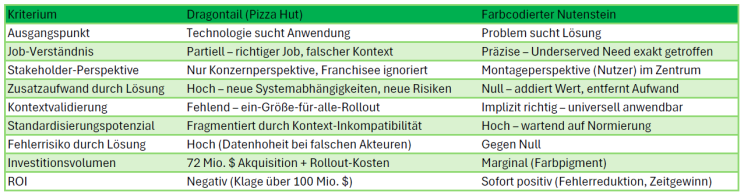
The lesson: Innovation is not a question of budget.
It would be too simplistic to dismiss Dragontail as an AI failure. The system is technologically impressive. It obviously works in over 1,500 restaurants worldwide – otherwise, Yum! Brands would never have bought it for $72 million and rolled it out so widely.⁵ The problem wasn't the technology.
The problem was a classic JTBD blind spot: The job of franchisee Chaac Pizza Northeast was not identical to the job Pizza Hut wanted to solve with Dragontail. Chaac's job was: "I want to control my delivery performance with DoorDash drivers and ensure customer satisfaction." Dragontail solved this by saying: "I want to optimize kitchen flow with our own drivers." This gap—as vital to JTBD as the air we breathe—was never addressed.⁷
The colored T-nut, on the other hand, didn't invest a single euro in a market research study. Someone simply took a close look at the pain that technicians suffer daily and developed a solution that directly eliminates that pain. That's outcome-driven innovation in its purest form.²
Tony Ulwick would say: If you know the user's desired outcome statement – "Minimize the time it takes me to identify the right T-nut" and "Minimize the likelihood of grabbing the wrong size on the first try" – then the solution is almost inevitable. Color is the most direct way imaginable to achieve both outcomes simultaneously.
What product managers and innovation leaders should take away from this
1. Technology is not a job replacement.
AI, digitalization, automation – all these are means to an end. The end is always the user's job. Those who choose the technology first and then look for the job it's supposed to solve risk missing the context – with consequences worth millions.¹
2. Context is not a detail – it is everything.
Dragontail works. But not everywhere. The question "For what context was this solution designed?" must be asked before every rollout. In JTBD (What to Be Done What You Do) terms: Same functional job, different context = different job. Anyone who overlooks this is building a bridge over the wrong river.
3. The simplest solution that gets the job done wins.
That sounds trivial, but it isn't. In innovation processes, we tend to equate complexity with value. The colored T-slot illustrates that sometimes the most revolutionary solution is the one no one expected – because it's so obvious once you understand the right job.
4. Use the job map for rollout decisions.
Before introducing an innovation in a new market, context, or with a new user group, ask: At which step of the job map does our solution create new effort? For Chaac, step 6 (Monitor) would have provided the answer: "The system gives third parties control that harms us." This insight would have become apparent in the pilot – if it had been sought.
5. The best moment for innovation is not the product presentation – it is the moment when the user stops having a problem.
Tim Freitag writes: “With a great deal of innovation and a flash of inspiration, we have brought about a small revolution in the T-nut, which is used millions of times.”² No big launch event. No press release. Just a LinkedIn post with five colors – and the quiet certainty that installers will now make fewer mistakes. This is the moment for which innovation is made.
Epilogue: Why I saved both posts
Because together they tell a story better than any textbook on innovation. On the one hand, a corporation with almost unlimited resources that uses a technologically excellent solution in the wrong place and is subsequently sued for $100 million.¹ On the other hand, a global market leader that, with a flash of inspiration and a bit of paint, improves a standard installed millions of times – and in doing so, hits the nail on the head regarding exactly what installers need every day.²
Jobs-to-be-Done teaches us: It's not the innovation with the biggest budget that wins. The innovation that wins is the one that does the right job best.
In that spirit: Green for M3. Blue for M4. And a clear head for the next innovation process.
#JobsToBeDone #OutcomeDrivenInnovation #ProductManagement #Lean #PokaYoke #AIImplementation #Innovation #B2BInnovation #ProductStrategy
Footnotes
¹ Tangalakis-Lippert, K. (2026, May 18). Pizza Hut Faces Lawsuit From Franchisee Over AI System. Business Insider. https://www.businessinsider.com/pizza-hut-ai-system-dragontail-lawsuit-franchisee-2026-5
² Freitag, T. (2026). LinkedIn post on the color coding of T-nuts. LinkedIn. https://www.linkedin.com/feed/update/urn:li:activity:7457387415368867840/
³ Ulwick, A.W. (2016). Jobs to be Done: Theory to Practice. Idea Bite Press. See also: HYPE Innovation (2024). A Deep Dive into the Jobs-to-be-Done Approach. https://www.hypeinnovation.com/blog/innovation-management-jobs-to-be-done-approach
⁴ Restaurant Dive (2021, May 27). Yum to acquire AI-based company Dragontail Systems for $72.3M. https://www.restaurantdive.com/news/yum-to-acquire-ai-based-company-dragontail-systems-for-723m/600911/
⁵ Retail & Leisure International (2021, September 8). Yum! Brands Completes Acquisition of Dragontail Systems. https://www.rli.uk.com/yum-brands-completes-acquisition/
⁶ Food on Demand (2021, June 10). Acquiring Dragontail, Yum Brands Nabs Order Management & Delivery Tech. https://foodondemand.com/06102021/acquiring-dragontail-yum-brands-nabs-order-management-delivery-tech/
⁷ Fortune (2026, May 19). Pizza Hut franchisee claims $100 million losses from 'cascading operational breakdowns' in AI adoption gone wrong. https://fortune.com/2026/05/19/pizza-hut-franchisee-lawsuit-ai-adoption-doordash-delivery-drivers/
⁸ Gizmodo (2026, May 19). Pizza Hut Franchisee Sues Over AI Delivery System, Alleges $100 Million in Damages. https://gizmodo.com/pizza-hut-franchisee-sues-over-ai-delivery-system-alleges-100-million-in-damages-2000760645
⁹ The Independent (2026, May 18). Pizza Hut's AI rollout has caused franchisee to lose $100 million. https://www.independent.co.uk/us/money/pizza-hut-ai-delivery-lawsuit-b2979021.html
¹⁰ Restaurant Business Online (2026, May 12). Franchisee files lawsuit against Pizza Hut over mandatory tech. https://restaurantbusinessonline.com/technology/franchisee-files-lawsuit-against-pizza-hut-over-mandatory-tech
¹¹ Emmanuel, J. (2025, October 2). Innovation That Doesn't Fail: Lessons from 'Jobs to Be Done'. LinkedIn Pulse. https://www.linkedin.com/pulse/innovation-doesnt-fail-lessons-from-jobs-done-jade-emmanuel-8jaae
¹² The Screw Shop (2025). DIN 508 Nuts for T-slots – T-nuts. https://shop.der-schraubenladen.de/DIN-508-Muttern-fuer-T-Nuten
¹³ REFA Institute (2023). Poka-Yoke – Avoiding unintentional errors. https://refa.de/service/refa-lexikon/poka-yoke
¹⁴ Product Plan (2026). Jobs-To-Be-Done Framework. https://productplan.com/glossary/jobs-to-be-done-framework


Comments